The short answer
AI technology enablement turns a defined business need into a usable tool or connected process. It includes scoping, building, testing, preparing users, and establishing ownership so the solution can function in everyday work.
Key takeaways
- Choose between a user-facing tool, a connected workflow, or a combination based on the problem.
- Test quality and exceptions alongside speed.
- Include handoff, maintenance, and team readiness in the scope.
Do you need an AI tool, a workflow, or both?
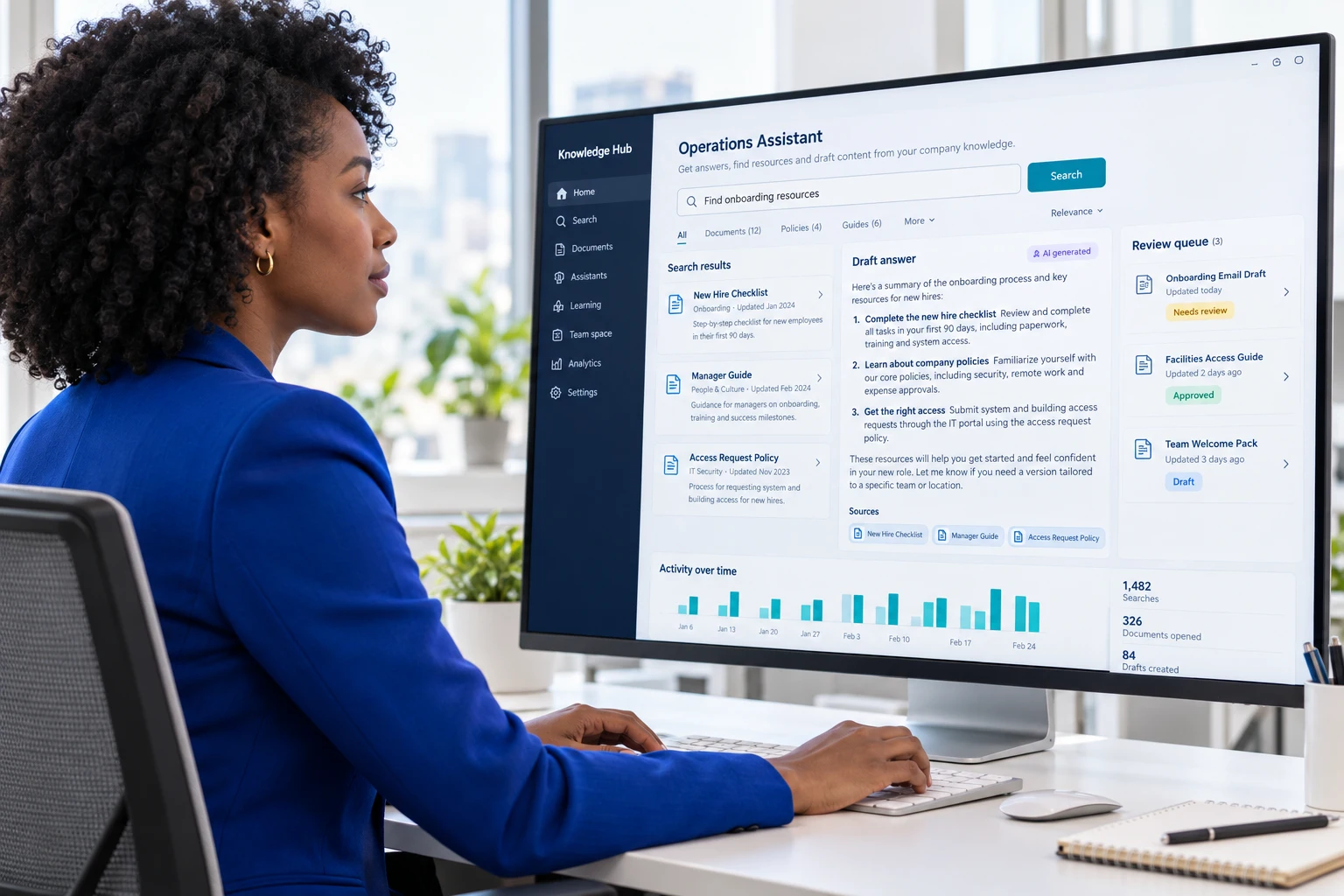
A tool gives a person a capability. A workflow connects tasks, systems, and decisions into a repeatable process. A company knowledge assistant is a tool; the process for receiving a question, retrieving approved information, reviewing uncertainty, and returning an answer is a workflow.
Many business solutions need both. Employees need a useful way to interact with the capability, and the company needs a process for managing what happens around it.
Start by describing the work that is difficult today. If the problem is locating approved information, a guided assistant may help. If work stalls between departments, the more important issue may be routing, responsibility, or an unclear approval step.
Write a build brief before selecting the technology
A brief should identify the user, the task, the expected output, the information available, and the people responsible for reviewing it. Include the company systems the solution may need to connect to and any access restrictions.
- User: Who will use the tool, and in what context?
- Input: What approved information starts the task?
- Output: What should be produced, and for whom?
- Review: What must a person check or approve?
- Success: What observable improvement matters?
Separate what the pilot must do from features that may be useful later. This makes it easier to test a coherent solution without turning a bounded business problem into an open-ended software project.
Choose how the capability will be built
There are three practical ways to engage:
| Delivery model | Best fit |
|---|---|
| Built for you | The company needs external delivery capacity and a defined handoff. |
| Built with you | The team wants to learn through collaborative design and testing. |
| Taught to your team | The company wants internal capability to build, use, and manage tools and workflows. |
ResumeATM provides hands-on training and collaborative development to help teams design, build, and test practical AI tools and workflows. Custom development can also be scoped around an internal application or a specific AI tool.
Test the output—and the exceptions
A successful demonstration is not the same as a dependable business process. Test realistic examples, missing information, conflicting inputs, and situations where the solution should stop or ask a person.
For a customer follow-up assistant, review whether the draft invents a commitment, omits a detail, or uses an inappropriate tone. For a knowledge tool, check whether answers point to approved sources and whether uncertainty is handled clearly.
The NIST AI RMF Core places measurement and management alongside governance and contextual understanding. In a scoped business build, this supports a practical habit: evaluate the solution in context rather than assuming a working interface proves its value.
Plan ownership and measure the business value
Agree who owns configuration, source information, access, corrections, and future changes. Include the documentation and training needed for the people who will use and maintain the solution.
Measure the original business problem using comparable work. A faster draft may have limited value if it creates more review time. Count the time spent preparing, checking, correcting, and completing the task—not only the time the AI spends generating an answer.
An illustrative calculation is: net task time saved = previous total task time − new total task time, including review and corrections. Financial value also depends on implementation costs, recurring costs, and whether the released capacity is put to productive use.
Pair technology enablement with governance and change management. A useful tool needs clear operating boundaries and people prepared to use it.
Common questions
What is the difference between a prototype and implementation?
A prototype demonstrates a capability. Implementation prepares it for an agreed operating context, including access, testing, ownership, user readiness, and support responsibilities.
Can ResumeATM build the tool for our company?
Yes. ResumeATM offers custom tool and workflow development, collaborative builds, and team training. Scope depends on the business need, systems, data access, and implementation responsibilities.
How should a company evaluate AI return on investment?
Compare task time, quality, corrections, operating costs, and adoption against a baseline. Assess financial impact only where the company has sufficient data and a reasonable basis for attribution.
Source & editorial context
NIST, AI Risk Management Framework 1.0: Core (2023)
ResumeATM’s practical recommendations are our own. References provide context and do not imply endorsement. Examples are illustrative, not documented client outcomes.
From insight to implementation
Bring us the work you need to improve.
We can build AI tools and workflows for your company, develop them alongside your team, or train your people to build and manage them—with governance and adoption support.
Discuss your AI priorities